Microwave Sensing, Signals and Systems
Source: https://radar.tudelft.nl/Facilities/ducat.php Parent: https://radar.tudelft.nl/Facilities/
Microwave Sensing, Signals and Systems
Department of Microelectronics
DUCAT
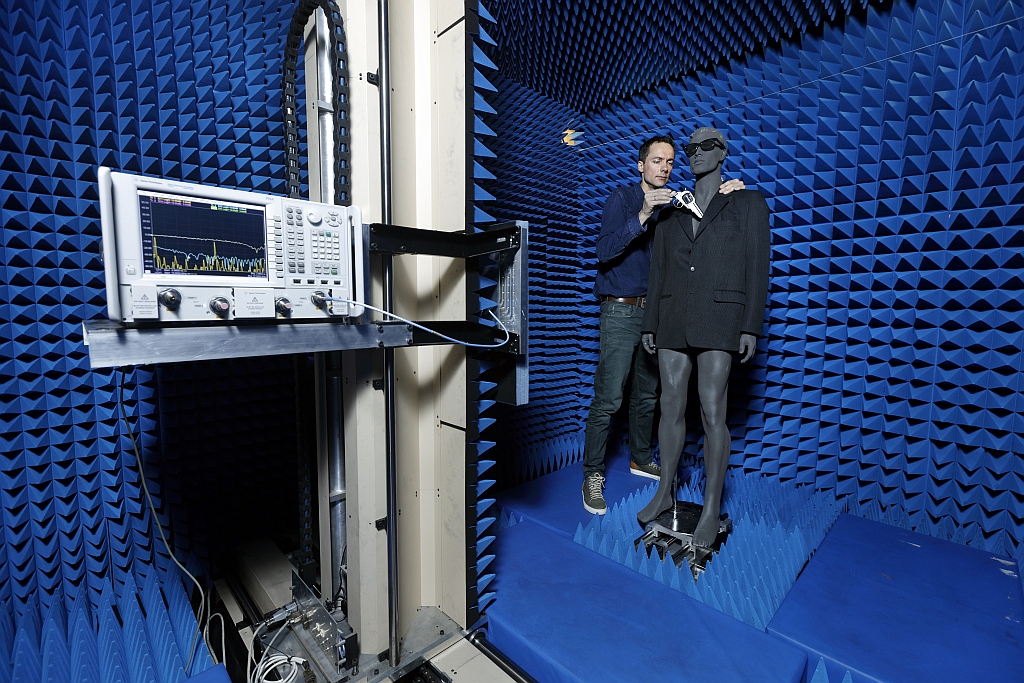
The Delft University Chamber for Antenna Tests (DUCAT) is a moderate size anechoic chamber which allows for far-field and near-field measurements thanks to a foldable inverted T scanner. It has recently been refurbished with new absorbers and stepping motors.
Inside of the DUCAT (near-field configuration)
Far-field mesurements configuration of the DUCAT
Chamber description
The chamber is a 6m x 3m x 3m Faraday cage providing 120 dB isolation ( at 10 GHz ) to reject external interferences. The walls, ceiling and floor are covered with RF absorbers with reflectivity performance below -40 dB from 1.2 GHz to 40 GHz. The maximum distance between the transmitting antenna and the antenna under test is 4 meters, meaning that a 10 cm aperture antenna is still in the far-field zone at 60 GHz.
Mechanical subsystem
The mechanical subsystem consists of 9 stepping motors.
The antenna under test (AUT) positioner is a roll over azimuth type, mounted on a dual axis translation stage to allow for accurate alignment of the AUT's phase centre with the rotation axis. The azimuthal resolution is better than 0.001 degrees.
The transmit antenna can be aligned in azimuth and elevation.
The foldable inverted T planar scanner has a 2m x 2m aperture. The resolution is better than 10um.
Configurations
Far-field
Planar near-field
Cylindrical near-field
Plane-polar near-field
RF subsystem
A 4-port vector network analyser is used as RF source and receiver for the antenna measurement set-up. The N5227A covers the frequency range from 10 MHz to 67 GHz with a dynamic range better than 120 dB thanks to the direct receiver access option which bypasses the internal directional coupler.
In addition a 24-port test-set can be used up to 20 GHz.
Dedicated phase-stable flexible RF cables are used with manufacturer specifications up to 50 GHz.
An object in scanner of the DUCAT
Near-field probes and standard gain horns
Our research group owns an array of near-field probes covering the frequencies from 1 GHz to 26 GHz. For far-field measurements standard gain horns are used which cover all bands from L to W (1 GHz to 110 GHz).
Additional Measurement Equipment
Following list of equipment is available for the MS3 group and can be used for measurements within DUCAT.
| Equipment Frequency band | |
|---|---|
| Network Analysers: | |
| Agilent HP 8753D | 30 KHz - 6 GHz |
| Agilent E 8364B | 10 MHz - 50 GHz |
| Agilent N5242A (4 ports) | 10 MHz - 26.5 GHz |
| Agilent N5227A (4 ports) | 10 MHz - 67 GHz |
| Millimeter wave extension modules: | |
| Agilent N5260-60003 | 67 GHz - 110 GHz |
| Multiport test set | |
| Agilent 87050A - K24 (24 ports) | 10 MHz - 20 GHz |
| Spectrum Analysers | |
| Agilent 8592A | 50 KHz - 22 GHz |
| Agilent 8565E | 9 KHz - 50 GHz |
| Arbitrary Waveform generator | |
| Tektronix AWG 5014B | 1.2 GS/s |
| Oscilloscopes | |
| Tektronix 784A | 1 GHz, 4 GS/s |
| Agilent DSO-X-91604A | 16 GHz, 40/80GS/s |
| Geozondas SD3003NF + SU4126NF | 100 MHz - 26 GHz (stroboscopic 10 MHz) |
| Power meters | |
| Anritsu ML2437A | up to 50 GHz |
| Agilent E4418A | up to 110 GHz |
Contact persons
[### prof.dr. Alexander Yarovoy
Scientific coordination](https://radar.tudelft.nl/People/bio.php?id=11) [### ing. Fred van der Zwan
Organization and technical coordination](https://radar.tudelft.nl/People/bio.php?id=108) [### ir. Pascal Aubry
Technical and research questions](https://radar.tudelft.nl/People/bio.php?id=109)
* * *
[### Back
Back to the MS3 group facilities](https://radar.tudelft.nl/Facilities/index.php)
Research Support
TU Delft Research Support portal
Agenda
-
No activities